
The impact of a product, material, or technology does not begin when it is put into use, nor does it end when its service life is over. Its life cycle starts with raw material extraction and continues through manufacturing, transport, installation, use, and end-of-life treatment. Each of these stages involves flows of materials, energy, and water that shape its overall footprint.
In this article series, we will look more closely at what we call a “life-cycle thinking” - a holistic framework that evaluates the environmental, social, and economic impacts of a product, service, or process across its entire life span rather than focusing solely on the manufacturing stage.

Driven by the need for companies to conduct clear, reliable Life Cycle Assessments (LCAs) and comply with EU sustainability regulations, the BLESS project was launched to make clear LCA methodology readily accessible.
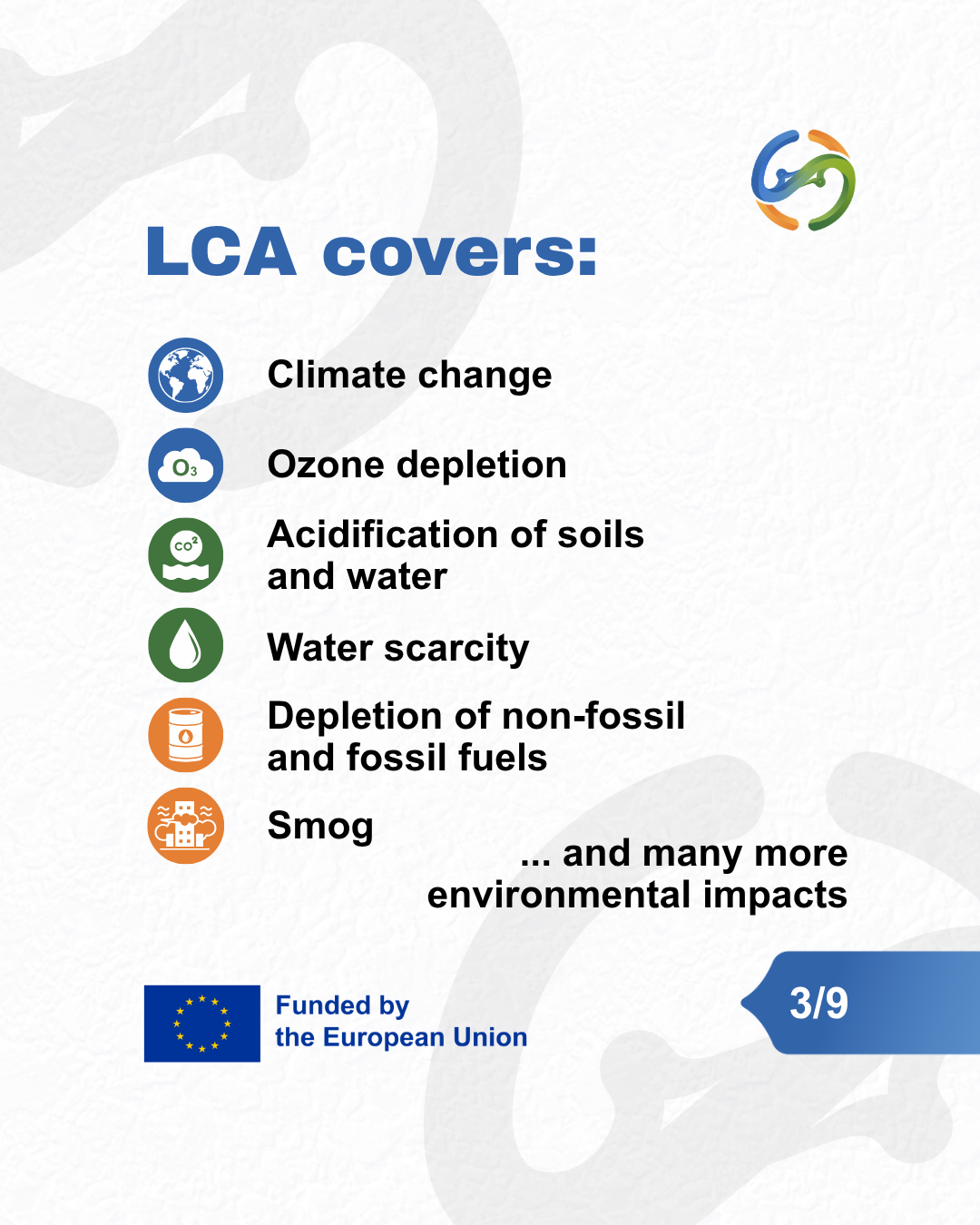
LCA is a systematic framework used to assess environmental impacts throughout the full life cycle of a product, material, technology or service. LCA covers a wide range of environmental impacts, the most known and visible being:
Climate change – due to fossil resources, bio-based resources or land use change
Ozone depletion
Acidification of soils and water
Over-enrichment of freshwater, seawater and land due to emission of nitrogen or phosphor-containing compounds
Depletion of non-fossil resources (minerals and metals) and fossil fuels
Photochemical ozone formation (smog)
Water scarcity
In the last decade, the LCA method has been widely developed within the fields of academia and policy making and has been increasingly applied by the industrial sector for analysing and communicating products’ environmental performance.
Standard LCA works best for already established and fully developed products where process data is available and LCA is applied ex-post. For emerging products and technologies, lab-scale prototypes, or long-lived products, a “Prospective LCA” (pLCA) is more suitable.
pLCA evaluates the potential future environmental impacts of emerging technologies by incorporating dynamic factors such as market changes, technological advancements, and policy shifts, thus modelling how their environmental performance may evolve when the technology reaches a large-scale production and market-readiness. By addressing the environmental impacts of technologies early in their development, pLCA supports proactive decision-making to ensure sustainability and safety throughout the lifecycle.
There has been a lot of development in the pLCA field in the past few years. Many new guidelines, frameworks, methodologies and other ideas have been proposed and developed. The goal of BLESS project is to make these ideas available to a broader audience and address persistent barriers to LCA uptake, particularly among small and medium-sized enterprises (SMEs).
This forward-looking approach aligns with the EU's Safe and Sustainable by Design (SSbD) framework, which emphasizes the need to design products and processes with sustainability embedded from an early stage of development.
The project also follows the principles of social LCA (s-LCA) within the SSbD framework and policy stack, evaluating the potential social and socioeconomic impacts of products and technologies across their entire life cycle. We will talk more about s-LCA in the second part of the series, so stay tuned!
